~ MamakTalk ~: 08/09/14

2014年8月9日 星期六

[Review] Huawei Honor 3C vs ASUS ZenFone 5 vs Xiaomi Redmi 1S vs Redmi Note.


Not everyone can afford to get the latest flagship smartphones. Fortunately, this year we've seen a trend where the battle between the smartphone companies isn't just focused on the flagship models, but also on the lower end of the scale. These phones offer exceptional value for money, packing a combination of hardware and software that is really hard to disagree with.
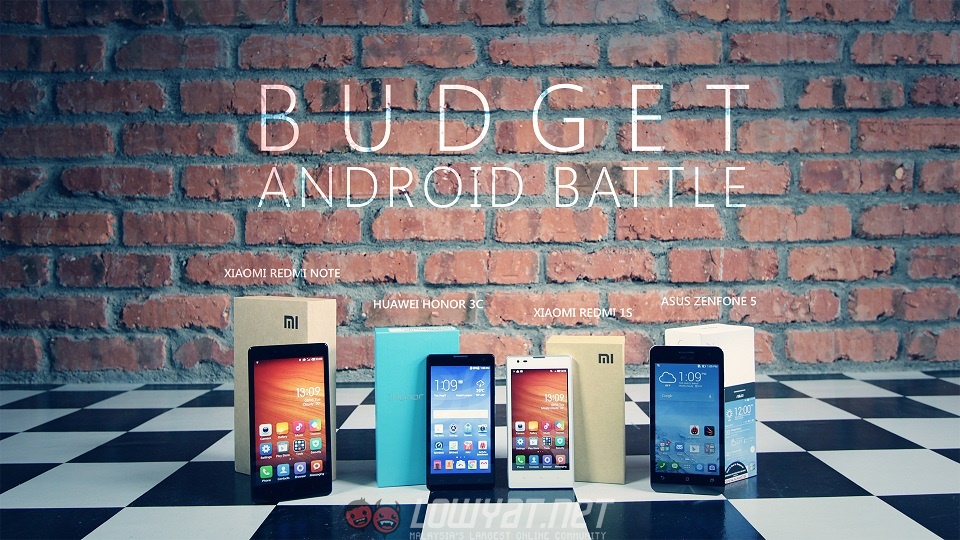
With that in mind, we thought, which is the best budget Android smartphone you can buy? We take a look at four candidates: the Huawei Honor 3C, ASUS ZenFone 5 and the Xiaomi Redmi 1S and Redmi Note.
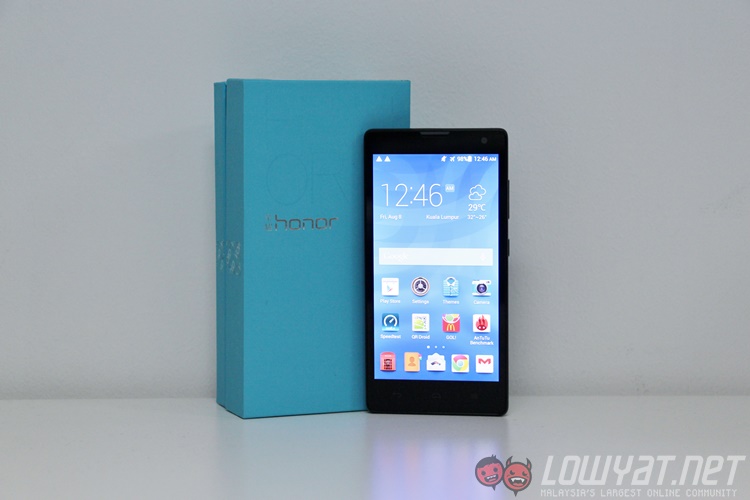
HUAWEI HONOR 3C
budget-android-battle-honor-3c
The first of the four to come to Malaysia, the Honor 3C stirred plenty of interest, offering a 5-inch 720p display with a quad-core processor AND 2GB of RAM in a package that was rumoured to cost less than RM600. Huawei almost broke the Internet when it eventually announced that the Honor 3C will be priced at RM499.
As far as budget Android smartphones went at the time, this was the pick of the bunch. When it was announced, the other smartphones in its price range offered no competition. It was the only smartphone at the time to offer a generous 2GB of RAM at this price range, which makes the phone run very well despite the old MediaTek MT6582 1.3GHz quad-core processor and Mali 400 GPU. There's no reason to complain about the 5-inch 720p display either.
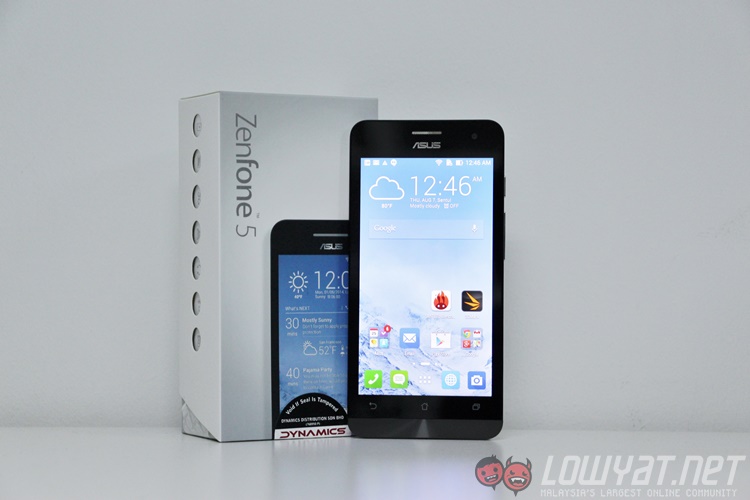
ASUS ZENFONE 5
budget-android-battle-zenfone-5
ASUS made plenty of headlines earlier this year with its latest ZenFone range. The company is better known for its PC hardware, and its earlier Android tablets were a hit-and-miss affair (with the exception of the Nexus 7, of course). But the ZenFone range was unique in the sense that they are powered by Intel's latest Atom processors, and feature a camera technology ASUS calls PixelMaster.
The ZenFone 5 is the middle child of the ZenFone family, and arguably the best deal of the lot. There's a 5-inch 720p display with the company's GloveTouch and PenTouch technologies for extra display sensitivity, 2GB of RAM, 16GB of storage and a 8MP rear camera with the aforementioned PixelMaster. This phone is running on Android 4.3 with a UI ASUS calls ZenUI, and the company has also promised an update to Android 4.4, but so far there's no information on that.
XIAOMI REDMI 1S

budget-android-battle-redmi-1s
The second Xiaomi smartphone to enter the Malaysian market, not many realise just how good this phone really is. At RM419, this phone packs serious value for money. Offering a Qualcomm Snapdragon 400 1.6GHz quad-core processor at a package this affordable is close to unbelievable. No wonder Xiaomi co-founder Bin Lin uses this as his daily driver.
Of the four smartphones here, the Redmi 1S is also the smallest of the bunch, offering "only" a 4.7-inch display. But, for those looking for a larger display, there's the Redmi's larger sibling, the Redmi Note.
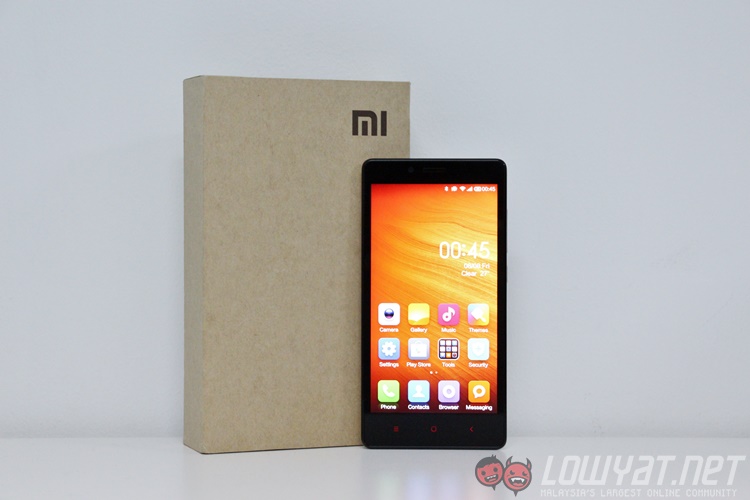
XIAOMI REDMI NOTE
budget-android-battle-redmi-note
The Redmi Note is Xiaomi's first phablet, catered to an ever-increasing market in the industry. Offering a large 5.5-inch 720p display, it was also one of the first smartphones to use MediaTek's MT6592 "true" octa-core processor.
And, in classic Xiaomi fashion, this phone packs some pretty serious hardware too. Besides the processor, the Redmi Note offers a generous 13MP rear and 5MP front-facing camera, while the 3200mAh battery means the phone won't be giving up on you towards the end of the day.
We've got quite a battle in our hands, so let's compare each of them by five aspects:design, hardware specs, software, camera and of course, price.
 

DESIGN

budget-android-battle-5
To be very honest, for devices at these prices, design is probably the last thing in every product manager's list of priorities. You won't find any metal unibody constructions,chamfered edges or anything with a semblance to "exquisite craftsmanship". That being said, these phones are still built to be durable enough to last its intended lifespan.
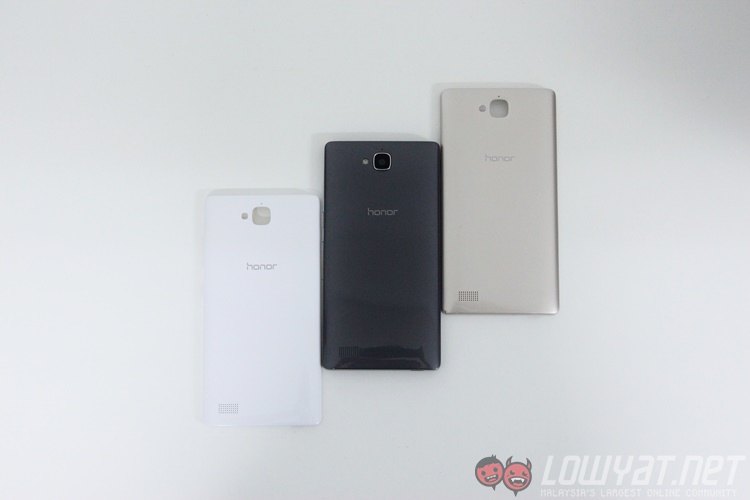
All of these phones are made from plastic, with every one of them offering exchangeable back covers. Hence, if you're not happy with that glossy white stock back cover, you can order a different one of your choice. The Honor 3C offers plenty of colours to choose from and can be purchased at RM19.90 apiece. The Redmi phones both offer an even more expansive set of covers, including some cool designs in addition to plain colours. But, you can only buy very few of them via its official webstore.
budget-android-battle-honor-3c-covers
xiaomi-malaysia-mi-3-covers
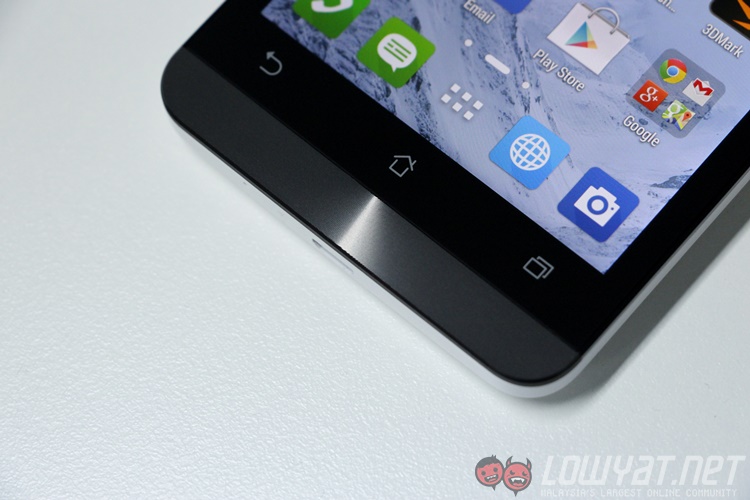
With that in mind, we think the best design offered by the four here is with the ZenFone 5. There's no glossy plastic back that makes it look cheap (even if it is), while the clean design follows through the front with a classy metallic band at the bottom, its circular concentric lines reminiscent of the company's super-desirable ZenBook laptops.
budget-android-battle-zenfone-5-4
WINNER: ASUS ZENFONE 5
 

HARDWARE SPECS
budget-android-battle-software
At the top end of the scale, almost every flagship smartphone pack the same set of hardware: Snapdragon 801, 3GB of RAM, Full HD/2K display…it's getting boring, and more importantly, reaching a point where these specs are overkill. Who needs a Quad HD display when the human eye can't even tell the difference anyway?
Down the pecking order, that's where things are really interesting. You've got the MediaTek-powered devices jostling for space alongside the Qualcomm-packed ones. Then, there's Intel, who are pushing hard with its own set of mobile chipsets.
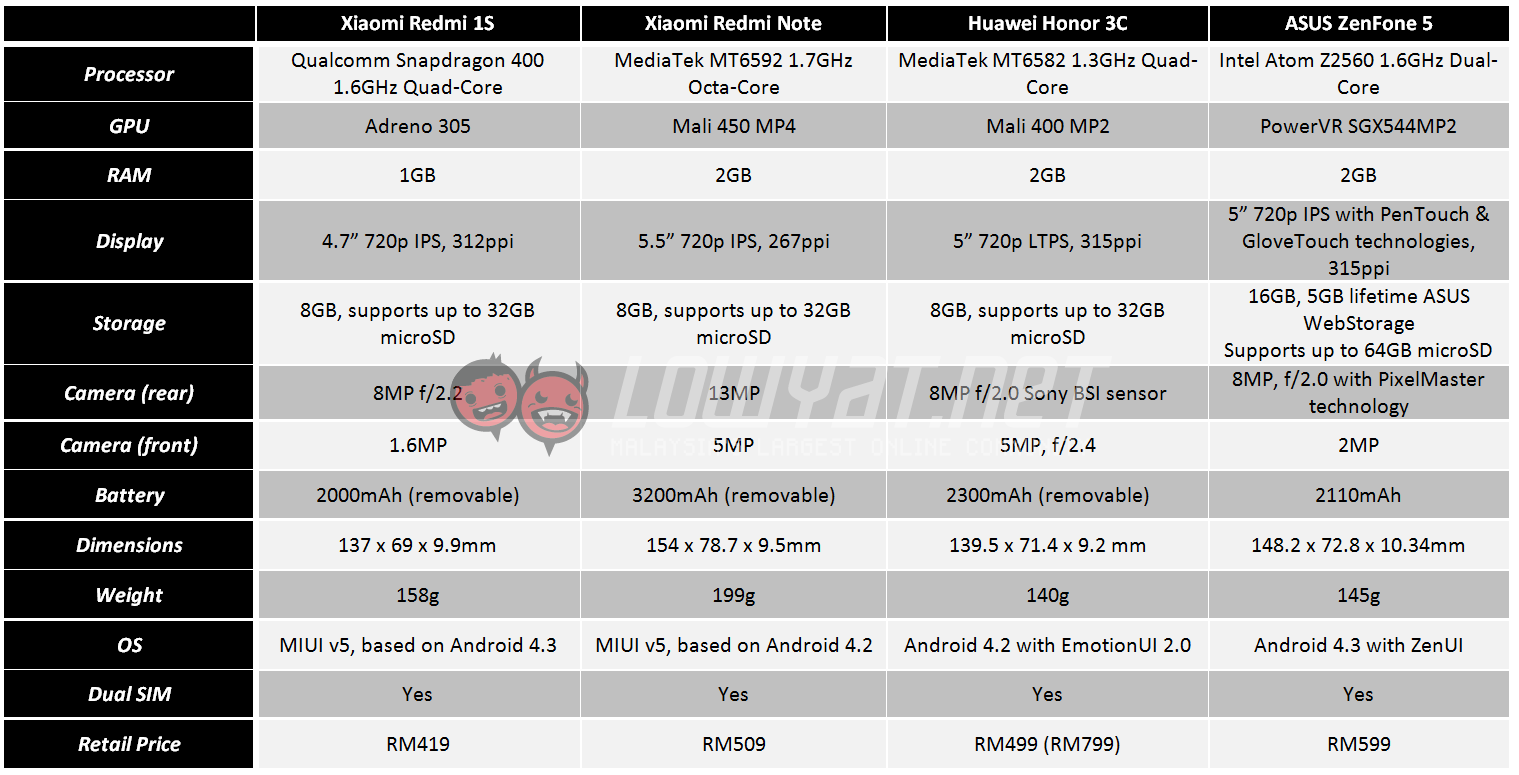
Which among the four has the best set of hardware, then? This table breaks it down:
redmi1s-redminote-honor3c-zenfone5-hardware-spec
As you can see, each device has its compromises. The Redmi 1S, for example, is the only phone here with 1GB of RAM, but is powered by arguably the most power-efficient chipset of the four. The Redmi Note offers the largest battery and display but is easily the heaviest phone of the lot. The Honor 3C sports a Sony rear camera sensor and has the best display of the four, but its processor and GPU are both very dated.
budget-android-battle-benchmarks
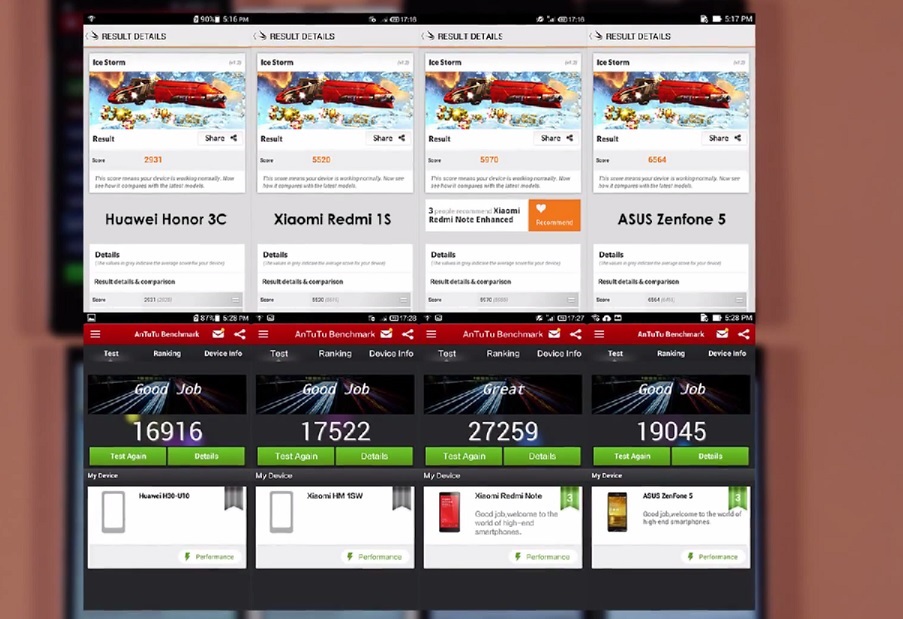
We ran two benchmarks to test out the hardware capabilities, and as we expected, they don't tell the full story. While the Redmi Note scored the highest points for both Antutu and 3DMark, the user experience on MIUI isn't as smooth as it is on the Redmi 1S. The ZenFone 5 actually scored higher than the Redmi 1S in benchmarks, but there are some concerns on battery life. The Honor 3C, with its dated hardware, scored last for both benchmarks, and you can actually notice jittery animations very often when using the phone, but the display is by far the best of the lot.
It's a tough one to call, since everyone has a different priority when it comes to what makes a good smartphone. This one's a draw.
WINNER: DRAW
 

SOFTWARE

budget-android-battle-3
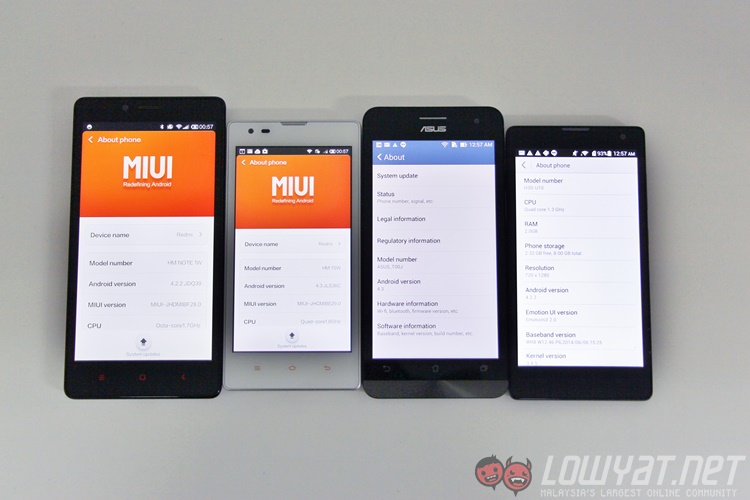
The two Xiaomi smartphones here run on MIUI, an Android-based ROM, which means that the software has been tuned aggressively to Xiaomi's flavour. While both phones run on MIUI v5, the Android versions they're based on are different: the Redmi Note is based on Android 4.2.2 while the Redmi 1S is based on Android 4.3.
On the other hand, the Huawei Honor 3C and ASUS ZenFone 5 both run on Android skins developed by their respective companies. The Honor 3C runs a skin called EmotionUI while the ZenFone 5 features a UI called ZenUI. Each of these skins brings their own set of customisations and unique features.
budget-android-battle-software-2
For example, EmotionUI (and MIUI) does not have an application drawer. Both Huawei and Xiaomi feel that the addition of an app drawer complicates things for new users, and so resorted to an iOS-style interface where all apps appear as icons on the home screens. These Chinese smartphones also feature different themes that can dramatically alter the look of the device. Xiaomi phones even come with a Themes store where you can download thousands of different themes, while the Honor 3C requires you to find third-party themes from its user forums, download and store them in a specific directory, and then install them. Quite a hassle, and probably not worth it.

budget-android-battle-zenfone-5-2
On the other hand, ZenUI feels responsive and light, with animations that are taken straight from stock Android – and that's a good thing. The prevailing use of light colours also lend to a clean and minimalist feel, which almost perfectly encapsulates the "Zen" in ZenUI.
All four devices also feature a simplified user interface. Whether it's Lite Mode, Easy Mode or even Simple Home Screen Style, all of them serve to make it easier and less daunting for first-time smartphone users or the elderly to navigate around the device.

budget-android-battle-lite-mode
However, the sheer customisability of MIUI gets our vote for this round. It's a tough call, but the newer version of Android on the Redmi 1S slights it in favour of the Redmi Note.
EDIT: It has been pointed out to us that the video states that the ZenFone 5 was the winner for this segment, which contradicts the above sentence. Originally, we did agree that MIUI would take the crown, but after a rather long discussion about ZenUI from a colleague who was using a ZenFone, we agreed that the light, near-stock Android feel and the surprisingly intuitive "What's Next" feature wins it for the ZenFone – though you can't go wrong with MIUI either.
WINNER: ASUS ZENFONE 5
 

CAMERA

xiaomi-redmi-1s-camera
The smartphone camera. Something which has become one of the most important aspects when choosing a smartphone. With the exception of the Redmi Note, all smartphones here feature 8MP rear cameras, which will be our main focus in this segment. Hence, for the Redmi Note we changed the image settings to shoot at 8MP.
For the first test, we snapped some shots indoors with a spotlight beamed at our subject (thank you, Lego Capt). Here are the image outputs from each of the phones, all captured in Automatic mode:
(Click for full resolution)

JpegASUS ZenFone 5
redmi-note-screenshotXiaomi Redmi Note
redmi-1s-screenshotXiaomi Redmi 1S
honor-3c-screenshotHuawei Honor 3C
As you can see, each of the phones produced images that are more than acceptable with plenty of detail. The only perceivable differences here are with the colour reproductions, where the Honor 3C and Redmi Note's images are a little washed out, while the ZenFone 5 slightly oversaturated the colours. The most accurate colours were actually from the Redmi 1S. That being said, we think the best overall image was taken on the ZenFone 5, only slightly edging out the Redmi 1S.
WINNER: ASUS ZENFONE 5
 
We did another camera test, this time in a darkened area of our office to test out the low-light capabilities of each smartphone camera. Here's how it went:
(Click for full resolution)

JpegASUS ZenFone 5
JpegASUS ZenFone 5 (Low-Light Mode)
redmi-note-low-light-screenshotXiaomi Redmi Note
redmi-1s-low-light-screenshotXiaomi Redmi 1S
honor-3c-low-light-screenshotHuawei Honor 3C
One would think that with the PixelMaster technology and the Low-Light mode, the ZenFone 5 would run away with this one, but that is not the case. The Honor 3C struggled all the way, while the Redmi 1S got the colour tint all wrong despite resolving a fair amount of detail. But it is the Redmi Note which found the best mix of brightness, detail and saturation. So what happened to the ZenFone 5? It overcompensated in brightness for both Automatic and Low Light modes, making the final image a disappointing one on both counts.
WINNER: XIAOMI REDMI NOTE

PRICE
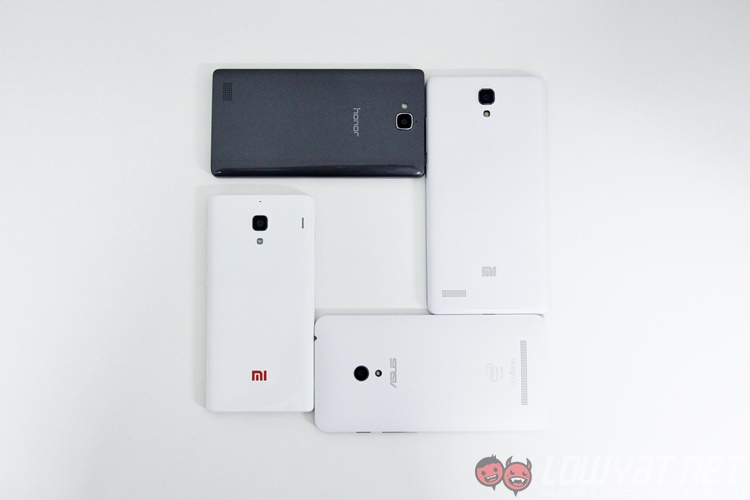
budget-android-battle-4
Ultimately, this is what many consumers looking for a smartphone in this price range will be focused on the most. While there are many who would be able to afford a top Android smartphone, there are many more who would go for the smartphone that offers the best value for money.
While each of these devices here offers exceptional value for money, the cheapest of the four is almost RM200 less than the most expensive one. Hence, the Redmi 1S wins this round.
WINNER: XIAOMI REDMI 1S

FINAL VERDICT
best-budget-android-phone-update
Let's take a look at our candidates once again. The Huawei Honor 3C may have been the top dog several months ago, but it has been surpassed by newer, more competitively-priced devices. The Redmi Note, on the other hand, is both chunky and has a processor that does well in benchmarks but less so in rendering scrolling animations – which can be deemed more important.
That just leaves us with two, the Xiaomi Redmi 1S and the ASUS ZenFone 5 – the cheapest and the most expensive devices in our list at RM419 and RM599 respectively. On the one hand, the Red mi 1S packs arguably the best chipset among the four – but is let down by its uninspired design and low RAM.
xiaomi-redmi-note-enhanced-redmi-1s-2
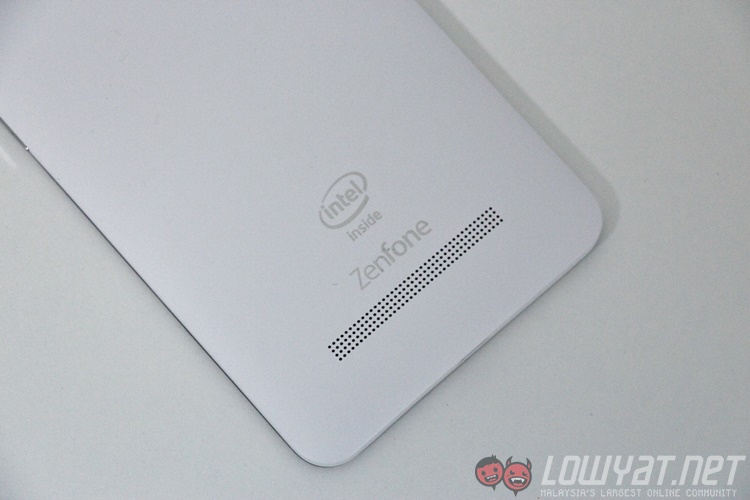
The ZenFone 5 is very handsome, has great build quality while its camera is actually pretty good. But, at RM599 it's a pretty hard sell considering that the Xiaomi Mi 3 – a significantly better smartphone – is just RM170 more.
budget-android-battle-zenfone-5-3
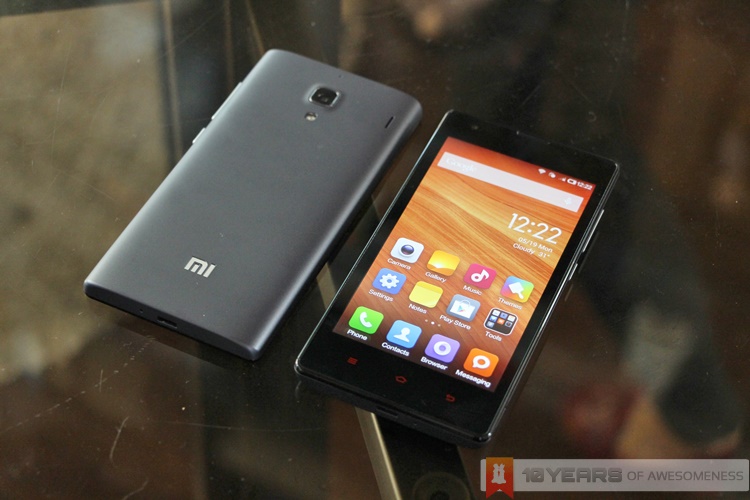
It's a very, very tight race in the end, but we feel that overall, the best value for money smartphone is the Xiaomi Redmi 1S. A solid performer in all five aspects we tested, it is also the cheapest of the four smartphones in this shootout. Combine that with the fact that you can even find Snapdragon 400-powered phones priced almost RM1000 more expensive than the Redmi 1S, and it's easy to see why this is the budget Android smartphone of our choice.
xiaomi-redmi-1s-hands-on-7
Just get the matte grey one. It looks a lot better.

Quartz Weekend Brief—Ebola’s real lesson, globally-warmed wine, Yemeni blood money, Tom Cruise


Ebola panic hit the US this week, and the WHO declared the current outbreak—the deadliest in Ebola’s 40-year history—an “international public health emergency.” Prominent US right-wingers fanned the flames of fear.


And yes, this outbreak should frighten us. But not the outbreak per se. Ebola is not that easy to catch—it isn’t an airborne infection, regardless of what some irresponsible pundits have said—and any country with half-decent health infrastructure can easily isolate patients and stop the disease from spreading.


The reason it has traveled so easily in Liberia, Sierra Leone, and Guinea is that their health infrastructure is simply horrendous. And that is why we should be worried. Because what if it weren’t Ebola?


Imagine a virus as deadly and untreatable as Ebola, but one that is spread by coughing and sneezing. Its transmission would be exponential—so swift that countries like the US would struggle to contain it. Worse, the more a virus spreads the more it replicates. That means more chances for it to mutate into an even more virulent strain.


We’ve had a small taste of this already. The 2002-03 SARS outbreak jangled nerves worldwide—but it happened in Hong Kong, a first-world city, and it was (just about) contained. A similar epidemic in Liberia, Sierra Leone, Guinea, or plenty of other places, could be catastrophic. By the time it reached the developed world, it might be beyond control.


So while the current hysteria about Ebola is misplaced, the basic sentiment isn’t unjustified. The health of the developed and the developing world are inextricably linked. And that’s the lesson rich countries should take from this Ebola outbreak: Third-world poverty isn’t just the third world’s problem.—Gwynn Guilford


Five things on Quartz we especially liked


What makes ISIL the worst. “Simply put, ISIL is an unholy combination of al-Qaeda, the Khmer Rouge, and the Nazis,” writes Bobby Ghosh, and the minorities in its sights in Kurdistan are at risk of genuine, old-fashioned genocide.


The ethics of driverless cars. What if the only way to avoid killing a child who steps into the street is to crash the car and risk killing the driver? Would you trust your self-driving vehicle to decide? Jason Millar poses a perhaps extreme hypothetical to highlight the moral dilemmas of designing autonomous robots.


The US’s top engineering schools are like Hogwarts. Someone jokingly compared Stanford, MIT, Caltech, and Harvard’s computer-science departments to the houses of Harry Potter’s school. Max Nisen took a look at where their graduates get jobs and found some truth to the characterizations.


New Yorkers should really quit complaining. A recent survey found New York to be the US’s unhappiest city: The rent is too high, the apartments too small, the summers too hot, the competition too fierce… Annalisa Merelli digs up some comparison that give the lie to the complaints (not that that will dissuade New Yorkers from their favorite pastime).


What a warmer world of wine will look like. Some French vintners call climate change “le bon problème“—it helps their grapes ripen and makes their vineyards more fruitful. But, explains Gwynn Guilford, the shifting temperatures will also cause all kinds of upsets, and leave wine-lovers both drunker and poorer.


Five things elsewhere that made us smarter


What is it with architects and chairs? “Buildings are all very well, but it seems you haven’t truly made it as an architect until you’ve given us something to sit on,” writes Ruth Metzstein in Intelligent Life. The chair often represents an architect’s grand vision, and pretenses, distilled down to a human scale. But they “have a reputation for being better to look at than sit on.”


How the internet destroyed the last real movie star. You may not care about Tom Cruise, or celebrities in general, but Amy Nicholson’s tale in LA Weekly about how the actor’s rise to fame coincided with the rise of independent gossip bloggers and viral videos—thus derailing what could have been a legendary career—is also a broader parable for the technology of our time.


Who paid off the mourners in Yemen? Last year a US drone strike killed 12 people at a wedding party near Radaa. In a remarkable piece of reporting for Buzzfeed, Gregory Johnsen tells the story of the local sheikh who took on the job of defusing tensions and channeling compensation to the families. But one mystery remains: Who provided the $800,000 in blood money?


A fascinating profile about a boring startup. Stewart Butterfield co-founded Flickr, the photo-sharing site. His new baby, Slack, is a messaging service that’s taken many companies (including us at Quartz) by storm. Remarkably, both Flickr and Slack were the byproducts of failed ventures. But as Mat Honan explains in Wired, they weren’t accidents at all.


The dark side of Abu Dhabi’s temples to high culture. Branches of Guggenheim, the Louvre, and New York University are all rising on Saadiyat Island, built by immigrant workers under often appalling conditions. Molly Crabapple reports for Vice on their plight, and reflects on how often the pinnacles of human art and intellect reside in buildings constructed on the sweat and (literal) blood of the poor.


Our best wishes for a relaxing but thought-filled weekend. Please send any news, comments, Tom Cruise GIFs, and uncomfortable chair designs to hi@qz.com. You can follow us on Twitter here for updates throughout the day.


Sign up for the Quartz Daily Brief here, tailored for morning delivery in Asia, Europe & Africa, and the Americas.


Quartz Weekend Brief—Ebola’s real lesson, globally-warmed wine, Yemeni blood money, Tom Cruise

Which “free” mobile apps are costing you the most money?


Instagram app on iPhone 4S

As the mobile internet has boomed, operators have tried to move their customers from unlimited-access data plans to consumption-based plans, where people pay based on how much mobile data they’re using. This push has been largely successful. For example, AT&T—the largest US operator—said last month that more than 80% of its smartphone customers, excluding prepaid, have usage-based data plans. That’s up from 45% three years ago.


The upshot: Using the mobile web and apps—even free ones—costs money. Of course, there are huge productivity and entertainment benefits to many apps. But now that data consumption represents a tangible cost, it’s interesting to see which apps are the most expensive, by bandwidth usage.


Fortunately, both major smartphone operating systems, Apple’s iOS and Google’s Android, allow users to see how much mobile data they’re consuming and which apps are using how much. Generally, viewing the Cellular section in the Settings app reveals total data consumption and per-app usage.


In my case, I’ve used 6.8 GB since I last reset my iPhone’s data counter a few months ago. Twitter turns out to be my biggest “expense”—my Twitter app has consumed 2.2 GB of data during that time, or almost one-third of the total. This seemed surprising at first: isn’t Twitter just 140-character text snippets? But with all the photos and videos in the Twitter stream today, plus loading websites in the built-in browser, addict-level usage adds up.


Instagram comes in second place, accounting for 20% of my usage—reasonable, considering all the hi-resolution photos it’s loading. Only three other apps—Safari, Podcasts, and Mail—top 5%.


Tap to expand image


It’s trickier to figure out the actual dollar costs for this consumption. Most people probably don’t use the entire allotment they pay for each month. And many people are on “shared” family plans, where bandwidth caps are distributed among multiple devices and people. But, roughly, I’ll assume that I’m spending about $10 per month to use Twitter on my phone. Knowing how much enjoyment I get, this seems fair.


We’re curious where your mobile bandwidth is going—and we’ve set up a quick, informal survey to learn more. If you don’t mind, please look up your total data consumption and top app, and share it with us through this form. If the results are interesting enough, we’ll follow up.


Which “free” mobile apps are costing you the most money?

Parenting hacks: easy ways to trick kids into loving math and science


Teach your children well.

Thanks to a charming Cheerios commercial, software developer Chad Miller was inspired to start a website. “This Is How to Dad” is not just full of parenting hacks—why you should buy your five-year-old a knife, how to teach them how to ride a bike—but also features some clever tips about how to encourage kids to become literate, numerate, and generally fond of learning.


Sure, there are apps for this kind of thing, but the best techniques only require some time and effort. We’ve highlighted a few of Miller’s tips and related advice from other sources for a not-even-close-to-complete guide to tricking—ahem, encouraging—children into becoming super-absorbent knowledge sponges.


One obvious note: “How to dad” is a catchy example of marketing verbification, but it’s really “how to parent” that matters here.


Teach kids their phone number by using your iPad as bait


Set the iPad’s access code to be your phone number. (Here’s how to make it longer than 4 digits.) Then teach kids when they’re lost to say, “Could you call my parents? My phone number is _____.”


Learn about probability by gambling (but not for money)


Mark Frauenfelder of Boing Boing, MAKE, and Cool Tools, carries dice in his pockets at all time so he can play the game Cee-Lo. “Like most betting games, Cee-lo has a rough reputation. But played among friends, not betting for money, it can be rather wholesome,” he says. The game can be played by anyone kindergarden age and above—here are the rules.


Play the takeaway game


Start with a big pile of objects—Miller uses jelly packets at his neighborhood dinner. Each player can remove one, two, or three items at a time. The last player to take an item wins. See who figures out the trick to winning, you or your five-year-old. (If you can’t stand losing: Think about multiples of four.)


Make your nerdy hobbies their nerdy hobbies


Exhibit A: This insanely detailed NASA spaceship and mission control simulator.


Buy a prism—after you remind yourself how they work


Prisms are cool! Look at the pretty rainbows! Did you know that all white light is made up of different colors of light, some with long waves and some with shorter ones? From there, work your way up to talking about Isaac Newton, with an occasional detour through The Rainbow Connection—it has no particular learning benefits, but it’s just a good song.


Teach kids how to factor large numbers


“Give the kid some chalk and a chalkboard and challenge them to tell you whether they can make a rectangle out of some number of dots,” Miller writes. “Don’t tell them they’re factoring numbers, and discovering multiplication and prime numbers.”


Can you make a rectangle out of 8 dots? (Not a line, note. Lines aren’t rectangles.)

Sure, 2 by 4.

How about 9?

Two by… nope that leaves a gap.

Not a rectangle. Make it wider.

Ah, 3 by 3 is a rectangle.

How about 10? 11?

How many rectangles can the kid make for 12?


Buy them Minecraft—they’re going to want it anyway


Tom Preston-Warner of the nonprofit group Codestarter, which provides laptops to kids who want to learn about computer programming, pre-loads the popular game as a default. “Kids LOVE Minecraft,” he writes. “Sure, it’s a game, but Minecraft encourages an engineering mindset where kids use their computer to build whatever they can dream.”


As Quartz has reported, Minecraft has become something like a massive open online course (MOOC). Part of the appeal is the game’s lack of an instruction manual, which forces users to figure things out on their own or go looking for fan-created user guides on YouTube.


Got your own tips? Leave an annotation on this post or share them on our Facebook page.


Parenting hacks: easy ways to trick kids into loving math and science

The chilling irony of the first US strikes on Iraq


A picture taken Monday, Feb. 13, 2012 shows, a U.S. F-18 fighter jet takes off from the Nimitz-class aircraft carrier USS Abraham Lincoln (CVN 72) during fly exercises in the Persian Gulf. The Carrier sailed from the Persian Gulf through the Strait of Hormuz on Tuesday.

And it’s not (just) that the bombers took off from the aircraft carrier USS George H.W. Bush, named after the first American president to go to war in Iraq. No, we’re talking about the targets:


US airstrike on ISIS today targeted artillery that had been abandoned by #Iraq army when it fled—
Rajiv Chandrasekaran (@rajivwashpost) August 08, 2014


To put it bluntly: It appears that the US is destroying artillery the US paid for, after it was abandoned to its enemies by troops the US paid to train. Under Saddam Hussein, the Iraqi army had significant heavy weaponry, but much of it was destroyed or decommissioned in the 2003 US invasion. Efforts to provide American-made mobile artillery was seen as a key step toward making the new Iraqi military an independent force. In the past few weeks, millions of dollars of US weapons have fallen into ISIL’s hands.


Backing up a step, the US is bombing ISIL, an Islamist militia that has taken over significant territory in Syria and Iraq, and now threatens the Kurdish capital of Erbil and numerous ethnic minorities.


Tap to expand image


While the US has technically withdrawn from Iraq, the government the has failed to maintain political unity, and the US-trained army is falling apart, leaving numerous Iraqis—and indeed, the fragile balance of Middle Eastern geopolitics—incredibly vulnerable. Despite reluctance to return to Iraq, President Barack Obama last night authorized air strikes to aid the Iraqi government and Kurdish militias known as peshmerga in their fight against the extremists.


That the first blows by American arms were struck against American arms is just one indication of complex and difficult the task is going to be.


The chilling irony of the first US strikes on Iraq

Italy should look to ancient Rome to reform its ineffective Senate


Man cleans Italian Parliament

The prime minister of Italy, Matteo Renzi, wants to miniaturize the Italian Senate—both in number of senators and in power. Under Renzi’s reform plan, Senators would be appointed by regional councils and have no power to approve budgetspass most national laws, or hold a no confidence vote on the government.


One of the touted motivations is to save money: the equivalent of about $58 million in salaries plus pension benefits. But even if it all added up to $100 million a year total, that would be only .005% of Italy’s $2 trillion a year economy. Any pluses or minuses for governance have to vastly outweigh the direct cost savings, so the issue should be thought of primarily as a constitutional issue, not a budgetary issue.


Italian senators are resisting. They have introduced almost 8000 amendments to Renzi’s reform bill to put the brakes on this constitutional change. This trench warfare was predictable. Back in March, James Mackenzie explained in Reuters that Renzi’s plan “to transform the Senate into a non-elected chamber stripped of the power to approve budgets or hold votes of no-confidence in a government” would meet stiff opposition:


[Renzi’s] bill would scrap the current fragmented system, which grants equal powers to the Senate and the lower house Chamber of Deputies but elects them by different rules which make it hard for any group to win a stable overall majority in parliament. …


But despite loud public calls for change from all sides of the political spectrum, the reform is expected to encounter strong opposition from many in the 320-strong upper house who will have to vote to scrap their own jobs.


Italian blogger Roberta Damiani gives an excellent primer on Renzi’s reform plan for the Italian Senate. She explains:


Currently, Italy has a system known as “perfect bicameralism”: both chambers are directly elected during the same general election, and have exactly the same authority on every matter, including monetary ones. This is really rare, especially in parliamentary systems; Italy and Romania are indeed the only two countries in the EU with such a system.


Such a system makes it hard to pass legislation. Right after Italy’s Fascist era under Mussolini, it made sense to make it hard for the government to do anything big. But now, when Italy faces a host of economic problems, that need imaginative solutions, it is a problem.


Ancient Rome provides the inspiration for a very different reform of the Italian Senate—a reform that doesn’t save any money on senators’ salaries, because it would let the senators keep their jobs, but would:


  1. End the gridlock caused by the current system;

  2. Elevate the Italian Senate as a deliberative body;

  3. Maintain the equality of the Senate with the other house of Parliament, the Chamber of Deputies.


The highest officials in the Roman Republic were two consuls. The consuls took turns running the show, with one consul in charge one month and the other in charge the next month. The consul who was in charge was said to hold imperium. One consul could veto the actions of the other, when the other was in charge, but used that power sparingly in order to avoid being checked in turn when it was his month.


For the modern Italian Parliament, here is what I am proposing: just as consuls in Ancient Rome took turns being in charge in alternate months, let the modern Italian Senate and the other house of Parliament, the Chamber of Deputies, be in charge in alternate years. Require an active vote by 55 percent of the house of Parliament that is not in charge to veto an action by the one that does. (To minimize opposition, leave the number of senators the same as it is now.)


Besides an occasional veto vote, what would a house of Parliament do during its off year? Although they might shirk in their duties, members of parliament in an off year would be expected to turn their house of Parliament into a kind of think tank, preparing and thinking through the actions they planned to take in the following year when they would again collectively be in charge. Having to watch the other house of Parliament be in charge during an off year would do a lot to stimulate creativity in putting together a program for the year when their house held imperium.


Under this system, the members of parliament could all keep their jobs, as long as the voters kept reelecting them. The fact that the house of Parliament in charge could pass legislation with a simple majority vote but the other house could veto only with an active vote of 55 percent would do a lot to reduce gridlock. The years each house of Parliament would go through having to sit on the sidelines would do a lot to foster deeper deliberation.


Italy has not been an easy country to govern.I think prime minister Renzi is trying to make things better, but he chose the wrong model for constitutional reform in Italy. For a better model—one that wouldn’t face the uphill battle of persuading senators to vote their own jobs out of existence—he can turn to the ancient Roman Republic, the source of so many of the world’s key democratic principles and traditions.


Follow Miles on Twitter at@mileskimball. His blog is supplysideliberal.com. We welcome your comments at ideas@qz.com.


Italy should look to ancient Rome to reform its ineffective Senate

Quartz Daily Brief—Americas edition—Gaza War restarts, Iraq airstrikes approved, Softbank struggles, Swedish muscle danger


What to watch for today


A return to fighting in the Gaza Strip. Israel’s military prepared to resume airstrikes on Gaza after 18 rockets were fired from the region, both before and a three-day ceasefire ended Friday morning local time. Israel said it was willing to extend the ceasefire under its original terms but refused Hamas’ demand to end the economic blockade of Gaza first.


Italian senators vote on whether to fire themselves. Prime minister Matteo Renzi’s flagship reform initiative would curb the senate’s power and unseat many representatives. The bill, which has received nearly 8,000 amendments, has to make two separate runs through both chambers of parliament.


Hawaii braces for double hurricanes. Category 1 Hurricane Iselle is expected to hit the Big Island with gusts of up to 85 mph (137 km/h), and her big brother Julio, a Category 2 storm, is on track to make landfall this weekend.


A North American employment bounce-back. The US Labor Department is expected to announce higher business productivity in the second quarter, which could slow a recent rise in unit labor costs. Canada’s unemployment rate for July is expected to remain at 7.1%.


While you were sleeping


The Reserve Bank of Australia announced gloomy forecasts. The central bank said GDP would grow 2-3% through June 2015, down from its 2.25-3.25% forecast three months ago. The bank’s also lowered its core inflation forecast and said the jobless rate would remain high “for some time.”


Ebola was declared an international public health emergency. The World Health Organization said the outbreak was “an extraordinary event” with particularly serious potential consequences, due to the virus’s virulence and the weak health care systems in the affected countries. The WHO suggested countries with the disease conduct exit screenings at all major ports and land crossings.


Softbank failed to inspire confidence. The Japanese wireless carrier posted a lower-than-expected first-quarter profit of 77.6 billion yen ($763 million), down 68% from the same period last year, as it struggled to grow in Japan’s saturated mobile phone market. CEO Masayoshi Son declined to answer questions about his failed attempt to acquire T-Mobile and combine it with Sprint, Softbank’s US wireless carrier.


The US authorized air strikes in Iraq. President Barack Obama said ISIL militants will be targeted if they move towards Erbil, the capital of Iraq’s Kurdish region, or if they interfere with US planes airlifting humanitarian aid to Yazidi refugees.


China’s trade balance took a positive swing… Exports rose 14.5% in July versus the same period last year, according to government data, almost double the expected rise. Imports fell 1.6%, creating a $47.3 billion trade surplus for the month and raising more doubts about China’s shift toward a consumer-driven economy.


…As it put foreigners on trial. A British and his American wife are facing charges of illegally obtaining information about Chinese citizens. Separately, an American working for a Christian NGO has been interrogated for three weeks, and a Canadian couple have been arrested for allegedly stealing state secrets. China’s criminal conviction rate is 99.9%.


Malaysia Airlines is being nationalized. The tragedy-prone airline will be restructured by the country’s sovereign wealth fund, which will spend 1.4 billion ringgit ($440 million) to delist the company’s shares. Minority shareholders will receive a 12.5% premium on the airline’s Thursday closing price.


Quartz obsession interlude


Svati Kirsten Narula on the real story behind secret menus that “exist at McDonald’s, Taco Bell, Burger King, Chipotle, Jamba Juice, and other restaurants, too. They’re hardly secrets, of course, but the word ‘menu’ connotes a curation of sorts, intentionality on behalf of the food establishment—and that’s at odds with the origin stories of most of these items.” Read more here.


Matters of debate


No, America isn’t becoming Libertarian. The future path of the Republican party lies elsewhere.


India’s economy is destined to overtake China’s. Because India is a free society.


The West should arm the Kurds. A strong Kurdistan is the only hope for what remains of Iraq.


Copyright laws are hindering animal artists. How are aspiring monkey photographers supposed to make a living?


Africa needs better data along with aid. Otherwise nobody will really know how the money is being spent.


Surprising discoveries


Bolivia has a train cemetery in the desert. It’s a rusted, graffiti-covered wonderland, if you’re into that sort of thing.


Highway deaths have plummeted since Colorado legalized weed. That is not to suggest causality, however.


Don’t tell white people the US justice system is racist. It makes them like it more.


Being too muscular in Sweden is cause for arrest. Cops suspected an “unusually large” man was on steroids.


62,000 chicken heads reversed a rabies outbreak. Swiss doctors dosed them with vaccine and fed them to infected animals.


Mark Zuckerberg carried a samurai sword in the office. He used it to “motivate” Facebook staff.


Our best wishes for a productive day. Please send any news, comments, unorthodox motivational techniques, and muscle-safe countries to hi@qz.com. You can follow us on Twitter here for updates throughout the day.


Sign up for the Quartz Daily Brief here, tailored for morning delivery in Asia, Europe & Africa, and the Americas.


Quartz Daily Brief—Americas edition—Gaza War restarts, Iraq airstrikes approved, Softbank struggles, Swedish muscle danger

Carmudi managing director explains what Philippine business culture is really like


The new managing director for car listings site Carmudi Philippines is Subir Lohani (pictured below). Unlike other Rocket Internet executives, who are typically from Europe and are parachuted into the emerging markets that the ecommerce giant intends to conquer, Lohani is actually from the Philippines.


Subir_pic2


Of Nepalese descent, Lohani moved to Metro Manila when he was just six months old, as his parents were to conduct diplomacy in the country. He grew up here and attended International School Manila, which is the most popular educational choice for the children of prominent businesspeople, politicians, and celebrities.


Lohani left the country in 2003 to attend Boston University, and then went into Singapore’s banking industry in 2008, at just 22, and he returned a few short weeks ago to spearhead Carmudi’s new direction in the Philippines. He is overtaking the position from outgoing managing director Nicolas Boldt, who will take on a new role as Carmudi’s global sales director, in a transition that officially ended yesterday, August 7.


To Lohani, Carmudi thus represents a new job as well as a fitting homecoming. “It feels good to be back,” he says. “This might sound cheesy, but it’s nice to give back to the country in some way through Carmudi.”


Got a business problem? Let’s hug it out


Though many people criticize Rocket Internet as being a clone factory, Lohani is focused on the value that it can provide to Filipinos regardless of their mother company’s ultimate goals. “We make it easier for Filipinos to find their dream car by doing two things – putting every car for sale in the Philippines online and verifying all details and photos of the vehicles ourselves before it’s placed on our website,” he shares.


RocketInternet

Carmudi Philippines shares an office with Lamudi Philippines.


Despite this admirable mission, Lohani still has to contend with the intricacies of Filipino business culture, which is vastly different from what he experienced abroad in China and Singapore, where things were more cutthroat.


“I would train my analysts to be extremely detail oriented by marking their mistakes on their documents (e.g. wrong font size) with a red marker,” Lohani says. “Being detail-oriented is such an important quality to have in a competitive industry banking because you need to spot things that other people don’t to get ahead of everyone else.”


This kind of approach would not fly in the Philippines, where harmony is more valued. “The Philippines has been ranked as the most emotional country in the world, and I think every manager here has to take that fact into consideration,” he points out. “People here get so close so fast, and Filipinos often refer to their colleagues as ‘family,’ as compared to other countries who never want to mix business with pleasure.”


This culture manifests itself in the smallest of details. “I am also familiar with this mindset because I grew up here, but to be honest, I still get caught off guard when I see a lot of hugging in the office,” Lohani confesses.


But this atmosphere is not without its charms and its perks. Upon his arrival, his Carmudi Philippines team welcomed him with a huge banner, and they’ve grown to treat him as Filipinos would normally treat a “kuya” (older brother) or “kapatid” (sibling).


Due to this mentality, Lohani has had to adjust his management style to Filipinos, and not the other way around. “A purely results-driven, high pressure environment does not seem to motivate Filipinos, but I believe in creating a comfortable family-like atmosphere where Filipinos are intrinsically motivated to work beyond their scope and become proud of what they accomplish,” he says.


To this end, the Carmudi office displays pictures of the team and even a family tree on the walls and windows, much in the same way a real Filipino family would. During the afternoon, Lohani hosts a wrap-up meeting in which the entire team gathers to celebrate each other’s accomplishments.


See: Rocket Internet continues its tear through Asia with the launch of vehicle classifieds platform Carmudi


Breaking Rocket Internet stereotypes


To anyone who has ever heard about the stereotypes said of Rocket Internet, the descriptions do not fit Carmudi Philippines, and therein lies the advantage of each venture under the Samwer brothers: every managing director is free to set the tone for their company in the way that will best allow them to meet their goals.


When Carmudi first started in the Philippines, the initial goal was to get the car listings online and grow the local team. Six months in, Carmudi Philippines has more than 20,000 listings and a staff of 40 employees, so Lohani is shifting the focus of the company toward account management and customer service.


“We call the dealers ourselves and provide tailor-fit advice to sell cars faster online, create reports with industry insights for them, and we even hold reunions for car dealership associations,” Lohani says. “I mean we can also do the usual follow-up calls and check-up visits, but I believe that one of the secrets of success to any company is creating that X-factor that turn clients into partners.”


Though Lohani is newly arrived to the Philippines after a long stint overseas, the umbrella of Rocket Internet gives him an existing network to tap into as Carmudi Philippines changes gears and tries to grow. There are already eight Rocket Internet companies operating in the country, including Zalora, Lazada, EasyTaxi, Lamudi, ClickBus, Lamido, FoodPanda, and PricePanda.


Though the Rocket Internet network allows Lohani to establish partnerships, such as offering Zalora discounts and EasyTaxi vouchers to bloggers who came to the recent launch of the Carmudi Android application, he sees knowledge sharing as the biggest advantage.


While each managing director has their own entrepreneurial style, Lohani feels that they are all united by their common desire to be number one in their respective sectors. He is thus eager to build close personal relationships with each one, so that they can mutually learn of better ways to scale in the unique market that is the Philippines.


With a confidence much more befitting the typical image of Rocket Internet, Lohani says, “we will probably discuss best case practices for each venture, some unique strategies we can employ to dominate the e-commerce industry – you know, those typical conversations people have over a cup of coffee.”


The post Carmudi managing director explains what Philippine business culture is really like appeared first on Tech in Asia.


Carmudi managing director explains what Philippine business culture is really like

Share this interesting post: